In June, Oklahoma Baseball reached the pinnacle of college baseball, capturing the 2026 NCAA Division I National Championship and the program’s third national title. The last time the Sooners won the College World Series was in 1994.
Behind that championship season was a commitment to preparation, player development and finding ways to make every rep count.
For Vince Rinaldi, Baseball Video and Analytics Coordinator for Oklahoma Baseball, HitTrax has become a consistent part of that process.
When asked how often the Sooners use HitTrax, his answer was simple:
“Daily.”
From offseason development and in-season preparation to independent player work, Oklahoma has integrated HitTrax throughout its training environment, giving players immediate information they can use to evaluate each rep, make adjustments and take greater ownership of their development.
Turning Coaching Points Into Measurable Results
During the offseason, Oklahoma uses HitTrax for what Rinaldi describes as “a little bit of everything.”
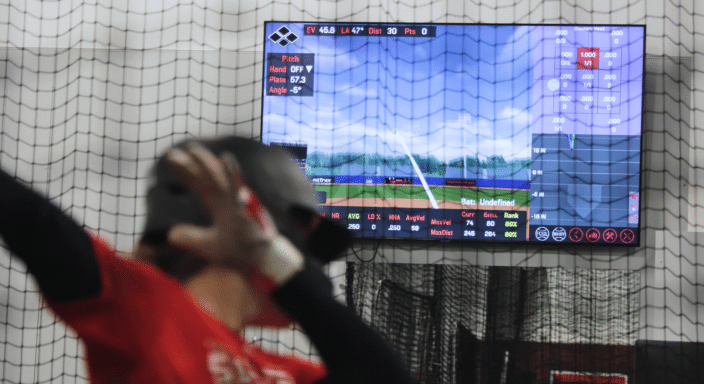
Located in the tunnel of one of the program’s main pitching machines, HitTrax is on “every day, all day,” allowing the coaching staff to incorporate data into a variety of approaches and drills.
One of the biggest benefits is the ability to quantify what coaches are teaching.
If Oklahoma is working on a two-strike approach, for example, HitTrax provides a live outcome that helps coaches and players evaluate whether the approach was successfully executed. Instead of relying solely on subjective observations, they have information to support the conversation.
That instant feedback can also help answer questions that are difficult to judge inside a cage: Where exactly was the pitch located? Was the ball hit hard? Was it a foul ball or a line drive down the line?
If a player pops up or rolls over three pitches in a row, the information available through HitTrax can help them recognize what is happening and begin figuring out why.
Creating Game-Like Training for SEC Competition
Oklahoma carries a similar approach into the season.
The Sooners aim to make their training environment as game-like as possible, using HitTrax to challenge hitters through drill work and prepare them for the quality of pitching they’ll see each weekend in the SEC.
But success isn’t always determined by where the ball lands.
At times, Oklahoma will intentionally disregard the outcome of the play and focus instead on pitch selection and approach.
A hitter may verbalize their approach before an at-bat. Coaches can then evaluate whether the player swung at or took a pitch based on the approach they established beforehand.
It creates another layer of accountability.
Rather than evaluating every rep solely by the result, Oklahoma can challenge its hitters to execute a specific plan — an important distinction when trying to create training that translates to game situations.
Giving Players the Freedom to Develop
HitTrax isn’t limited to structured team practices, either.
Because the system is easy for players to operate, Rinaldi created walkthrough guides that are posted alongside it. Players are free to use HitTrax outside of practice windows, giving them another opportunity to take ownership of their development.
Whether they’re working with coaches or training on their own, the immediate feedback provides enough information to recognize what went well, understand what may have gone wrong and develop a plan to get back on track.
For Oklahoma, the technology becomes more than a coaching tool. It becomes a resource players can use independently.
Finding the Right Data for the Right Drill
With so much information available, more data isn’t always the goal.
Instead, Oklahoma focuses on the information that matters for the specific objective of that day’s training.
Some of the HitTrax data Rinaldi and the staff regularly use includes strike zone information, exit velocity, launch angle, distance and quality of contact, along with the ability to hit in different virtual stadiums.
Which metrics receive the most attention depends on what players and coaches are trying to accomplish during that particular session.
That allows the data to support the purpose of the drill rather than allowing the numbers to become the purpose themselves.
Putting Video Analysis in the Players’ Hands
That player-first approach extends to HitTrax ViewPoint, the platform’s video analysis module.
At Oklahoma, Rinaldi says ViewPoint usage is largely player-led.
The Sooners already incorporate a significant amount of video and technology into their development process, so players are given the flexibility to decide how much — or how little — information they want to use.
ViewPoint and HitTrax reports provide immediate feedback when players are working through adjustments or developing new movement patterns, often following drill work with coaches.
For players who want additional information, the ease of use and quick turnaround allow them to dive deeper into their reps. Other players may choose to use less.
And that difference is intentional.
Not every athlete processes information the same way or needs the same amount of data to perform at their best. By giving players the ability to determine what works for them, Oklahoma is helping them learn how to evaluate their own game.
As Rinaldi explained, that becomes particularly valuable as players eventually leave Oklahoma and begin their professional baseball journeys. Learning how to use video, interpret information and understand how much feedback they personally need can help players begin to take control of their own development.
Using Competition to Reinforce the Details
One HitTrax feature Oklahoma uses particularly often is Situational Hitting.
According to Rinaldi, the Sooners use it daily.
How the system is used can change depending on what the coaching staff is teaching that day, allowing the technology to fit naturally into the flow of practice.
Situational Hitting can be especially valuable when there are only 30 minutes remaining at the end of a long practice. Instead of simply taking additional swings, players can continue working on the finer details of their approaches through specific situations and objectives.
It also gives coaches the ability to challenge different players based on execution rather than skill set alone.
The result is competition with a purpose: players are still competing, but the emphasis remains on executing the approach being taught.
Developing Championship-Level Habits
Oklahoma’s run to the 2026 national championship was ultimately decided on the field. But the habits that prepare players for those moments are built through countless reps long before they arrive in Omaha.
For the Sooners, HitTrax has become one of the tools supporting that everyday development process.
One day, that might mean quantifying a two-strike approach. Another might focus on pitch selection, quality of contact or situational execution. And when structured practice is over, players can continue using the technology independently to better understand their own swings.
The common thread is feedback.
By combining coaching with objective data, video and game-like outcomes, Oklahoma can give its players more information about each rep without taking ownership of the development process away from the athlete.
Instead, players are given the tools to ask better questions, recognize patterns and understand what they need to make an adjustment.
For the 2026 National Champion Oklahoma Sooners, those details are part of the everyday work behind competing at college baseball’s highest level.